
Developers of custom software and educational simulations.
|
Note: This page is no longer being maintained and
is kept for archival purposes only. For current information see our main page. |
|
|
Kurtz-Fernhout Software Developers of custom software and educational simulations. |
| Home ... News ... Products ... Download ... Order ... Support ... Consulting ... Company |
|
PlantStudio Product area Help System Index Introduction Quick Tour Tutorial Wizard Arranging Breeding Nozzles/tubes Animations DXF Parameters How it works Strengths/limits Registering |
Using the Parts panel to evaluate biomass distribution
The Parts panel on the main window (click the Parts tab) shows you how the
biomass in the plant is divided up at any time in the plant's life. You can't change anything in the Parts panel; it's just for you to review how your plant is growing.
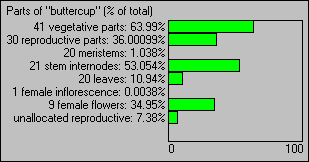 On each line of the Parts panel is a percentage of the total plant biomass at
any time. This shows you how the biomass is distributed. If any type of biomass
is not shown, there is no biomass of that type on the plant.
Vegetative/reproductive biomass
The first two lines in the parts panel divide the total plant biomass into two
parts: vegetative and reproductive. This breakdown is directly determined by
the parameters General: Age at which flowering starts and General: Fraction of total plant biomass at maturity in reproductive structures.
Vegetative parts
Starting at the third line in the Parts panel are listed each type of
vegetative part (meristems, internodes, and leaves), with the amount of biomass taken
up by all objects of each type. For example, in this buttercup plant, the
internodes are taking up much more biomass than the leaves, which means the Optimal plant biomass parameter is higher than it probably should be in the Internodes section and lower than it should be in the Leaves section. In this example the meristems have only a little biomass; this is
probably because most of them are inactive (no branching), and one of them has
already produced an inflorescence.
Reproductive parts
Under the vegetative parts are listed the reproductive parts (inflorescences,
female/male flowers/flower buds, fallen flowers, unripe fruits, ripe fruits).
In this example the inflorescence uses very little biomass, and the flowers use
much more. There are no fruits on this plant, as you can see.
Unallocated biomass
Under the reproductive parts are listed two important numbers: the amount of
biomass that is in the plant but could not be allocated to any plant parts
(vegetative and reproductive handled separately). This means that the daily demands
made by plant parts fell short of the actual new biomass that was available.
When this happens the extra biomass is placed in this holding area until it is
needed. You should try to minimize the amount of biomass shown here. Amounts
shown here are usually due to one of two things.
On each line of the Parts panel is a percentage of the total plant biomass at
any time. This shows you how the biomass is distributed. If any type of biomass
is not shown, there is no biomass of that type on the plant.
Vegetative/reproductive biomass
The first two lines in the parts panel divide the total plant biomass into two
parts: vegetative and reproductive. This breakdown is directly determined by
the parameters General: Age at which flowering starts and General: Fraction of total plant biomass at maturity in reproductive structures.
Vegetative parts
Starting at the third line in the Parts panel are listed each type of
vegetative part (meristems, internodes, and leaves), with the amount of biomass taken
up by all objects of each type. For example, in this buttercup plant, the
internodes are taking up much more biomass than the leaves, which means the Optimal plant biomass parameter is higher than it probably should be in the Internodes section and lower than it should be in the Leaves section. In this example the meristems have only a little biomass; this is
probably because most of them are inactive (no branching), and one of them has
already produced an inflorescence.
Reproductive parts
Under the vegetative parts are listed the reproductive parts (inflorescences,
female/male flowers/flower buds, fallen flowers, unripe fruits, ripe fruits).
In this example the inflorescence uses very little biomass, and the flowers use
much more. There are no fruits on this plant, as you can see.
Unallocated biomass
Under the reproductive parts are listed two important numbers: the amount of
biomass that is in the plant but could not be allocated to any plant parts
(vegetative and reproductive handled separately). This means that the daily demands
made by plant parts fell short of the actual new biomass that was available.
When this happens the extra biomass is placed in this holding area until it is
needed. You should try to minimize the amount of biomass shown here. Amounts
shown here are usually due to one of two things.
 Speed-limit parameters such as Minimum days to grow in several of the parameter sections can make the plant's S-curve of growth overstep its ability to allocate the new biomass to plant
parts. To solve this problem, you can reduce some of these speed-limit
parameters and/or increase the lifespan of the plant (General: Age at maturity). For reproductive parts, changing the parameter General: Age at which flowering starts can give the reproductive parts more time to grow.
If the amount of biomass each plant part attempts to accumulate is too low,
there will be some biomass left over. This parameter is called Optimal final biomass in the Internodes, Leaves, Female/Male Flowers, Female/Male Inflorescences, and Fruit sections. You can figure out what these percentages should be roughly by
dividing one hundred percent (the standardized maximum plant biomass or MPB) by the
number of internodes, leaves, etc on your plant. You don't have to figure it out yourself; just change the appropriate parameter. The
plant will immediately regrow and you can go back to the Parts panel and see if
there is still some unallocated biomass. If you require too much biomass for
any type of plant part, though, you might cause the plant to make fewer parts and
appear smaller.
Complete list
The complete list of biomass types shown is: all vegetative; all reproductive;
meristems; stem internodes; seedling leaves; leaves; female inflorescences;
female flower buds; female flowers; male inflorescences; male flower buds; male
flowers; fallen flowers (only shown if flowers have fallen off by the parameter Female/male Flowers: Days until drop if fruit not set); unripe fruits; ripe fruits; fallen fruits (should never appear, left over
from previous work); unallocated vegetative; unremoved vegetative (should never
appear, left over from previous work); unallocated reproductive; and unremoved
reproductive (should never appear, left over from previous work). Speed-limit parameters such as Minimum days to grow in several of the parameter sections can make the plant's S-curve of growth overstep its ability to allocate the new biomass to plant
parts. To solve this problem, you can reduce some of these speed-limit
parameters and/or increase the lifespan of the plant (General: Age at maturity). For reproductive parts, changing the parameter General: Age at which flowering starts can give the reproductive parts more time to grow.
If the amount of biomass each plant part attempts to accumulate is too low,
there will be some biomass left over. This parameter is called Optimal final biomass in the Internodes, Leaves, Female/Male Flowers, Female/Male Inflorescences, and Fruit sections. You can figure out what these percentages should be roughly by
dividing one hundred percent (the standardized maximum plant biomass or MPB) by the
number of internodes, leaves, etc on your plant. You don't have to figure it out yourself; just change the appropriate parameter. The
plant will immediately regrow and you can go back to the Parts panel and see if
there is still some unallocated biomass. If you require too much biomass for
any type of plant part, though, you might cause the plant to make fewer parts and
appear smaller.
Complete list
The complete list of biomass types shown is: all vegetative; all reproductive;
meristems; stem internodes; seedling leaves; leaves; female inflorescences;
female flower buds; female flowers; male inflorescences; male flower buds; male
flowers; fallen flowers (only shown if flowers have fallen off by the parameter Female/male Flowers: Days until drop if fruit not set); unripe fruits; ripe fruits; fallen fruits (should never appear, left over
from previous work); unallocated vegetative; unremoved vegetative (should never
appear, left over from previous work); unallocated reproductive; and unremoved
reproductive (should never appear, left over from previous work).
|
|
Updated: March 10, 1999. Questions/comments on site to webmaster@kurtz-fernhout.com. Copyright © 1998, 1999 Paul D. Fernhout & Cynthia F. Kurtz. |